


ALPA’s Absolute Commitment to Our Profession
By Capt. Jason Ambrosi, ALPA President
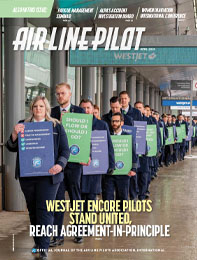
As this issue goes to press, we’ve witnessed again the power of unity, the commitment to our profession, and the strength of moving forward together. WestJet Encore pilots—who are among some of the lowest-paid regional pilots in Canada and negotiating with a company that refused to acknowledge the contributions of the employees—have finally reached an agreement-in-principle subject to the completion of final contractual language.
This hard-earned agreement follows seven months of negotiations with a management that continued to ignore the fundamental fact that without drastic improvements to career progression, seniority, and compensation, WestJet Encore pilots would seek better employment opportunities elsewhere. With the full support of ALPA and our vast resources, Encore pilots, who joined ALPA in 2017, took a series of steps to secure a collective agreement, including putting their company on notice when an overwhelming number of members voted to approve a strike ballot in preparation for a legal strike.
At the same time, we continue to provide our full support to our members at Air Canada, Air Transat, Air Transport International, FedEx Express, Frontier, JetBlue, PAL Aerospace, Spirit, and those of every pilot group in negotiations facing the all-too-familiar theme of management intentionally overlooking how company success is driven by employees. The specifics at each property in negotiations may be different, but the struggle is the same. We stand in solidarity with each and every pilot fighting for a fair contract.
We also continue our fight to keep our skies safe. At a time when the North American airline industry has achieved an extraordinary safety record, we still must defend our position of maintaining at least two pilots on an airline flight deck at all times—even though recent news media headlines about near misses and equipment failures have touted the heroic actions of airline flight crews. Our position is also backed by the Department of Transportation (DOT) and by NASA research. The DOT’s recent decision to mandate at least a two-crew team on most freight and passenger railroad operations reaffirms that airline safety demands two highly skilled and well-trained pilots at the controls of every airliner. And even though NASA research and data show that human intervention causes safety, some airlines and manufacturers continue to put profits over safety.
Since 1931, ALPA has been the conscience of the airline industry. Our absolute commitment to safety has been a guiding principle for the work we do. One of the most important ways we can ensure that we keep our skies safe and secure is through effective advocacy with lawmakers and regulators. Through line-pilot input, we make our voice heard loud and clear.
Over nine decades, ALPA has been committed to learning from past incidents and accidents so that we don’t repeat them in the future. Our Accident Investigation Board trains members to participate in NTSB and Transportation Safety Board of Canada accident and incident investigations whenever ALPA is a party, observer, or technical advisor to an investigation, critical work that ensures that the line-pilot perspective and pilot expertise are represented in these investigations.
We also understand that there’s more we can do to make certain that pilots are always well rested and ready for duty. We recently hosted the Fatigue Management Seminar, in partnership with Airlines for America, to bring together pilots, government and industry representatives, safety advocates, and researchers to discuss ways to mitigate the risks posed by pilot fatigue.
ALPA is also striving to build a profession that’s accessible and welcoming to everyone who dreams of becoming an airline pilot. By supporting aspiring pilots and encouraging them into our profession, we make ALPA and our industry stronger. Through mentorship and outreach at events like the Women in Aviation International Conference, we’re building an industry that’s more inclusive and inspiring individuals from various backgrounds to pursue aviation careers.
Technology is always advancing, and so, too, are pilots. We learn from the past, advocate for the future, and remain absolutely committed to the safety of our skies—and to our profession.